Denver Metropolitan Area Real Estate Market Conditions
The Denver Metro Area Real Estate Report includes detailed descriptions of the residential, retail, office and industrial segments of the Denver real estate market, as well as information on Denver economic conditions and the Denver economic base. Additional information of current real estate financing conditions and real estate investment criteria is also part of the Report. The Denver Metro Area Real Estate Report is updated quarterly and is available for purchase by contacting James Real Estate Services, Inc. A summary of the current Denver Metro Real Estate Market Conditions follows:
The economy of Colorado and the Denver metropolitan area is largely driven by four industries with a potential fifth: information technology/communications, aerospace, tourism and energy with biotechnology growing rapidly. The slowdown in the national economy in recent years, with uncertainties over the credit crunch and its effect on the world economy has affected the Denver economy.
Over the long term, Denver continues to be a popular location for real estate development, investment, and lending. The metropolitan area has a high standard of living, ranks frequently on national media “best of” lists and provides a business-friendly environment. The 2010 population of Colorado has increased to 5.2 million with over 2.8 million in the seven-county Denver metro area. Denver is now the 21st largest metro in the United States. One of the greatest challenges for Denver is how to properly accommodate future growth while protecting the natural environment that attracts people to the city and state.
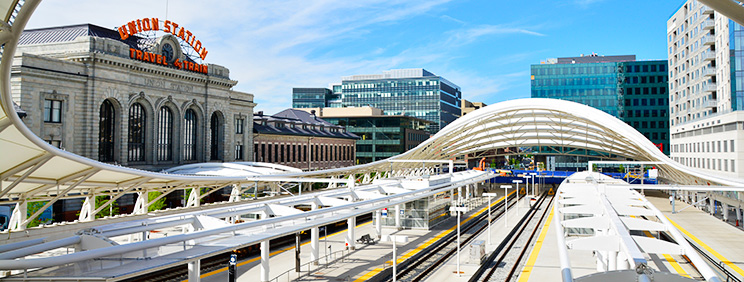
State and local governments in the Denver metropolitan area continue to invest in infrastructure projects that will maintain the area’s long-term viability. Construction was completed in 2006 on $1.67 billion T-REX, a massive highway and light rail project along Interstate Highway 25 in southeast Denver from the Broadway station south to Douglas County, including a spur along I-225 to Aurora. And the Denver Art Museum expanded with the new Hamilton Wing designed by world renowned architect Daniel Liebeskind. In late 2004 Denver-area voters authorized a 0.4% sales tax increase for FasTracks, a $6.7 billion transportation project that will essentially complete a massive rail and bus transportation system throughout the metro area. Conversion is under construction of Union Station into a multi-modal transportation hub for light rail, commuter rail, AMTRAK, local and regional buses and taxis. Developments continue of additional parks and open space, and local road and street projects
--------------------------------------------------------------------
During the late 1980s, virtually all categories of real estate in Colorado were overbuilt. Demand declined due to economic conditions, resulting in soft markets. The economic expansion of the 1990s, however, stimulated demand for all types of real estate, which resulted in vastly improved market conditions by the mid and later years of the decade.
As demand accelerated, sale prices of many investment-grade properties reached replacement cost once again encouraging speculative development. Markets generally remained in a healthy balance until the local and national economies fell into recession in 2001 exacerbated by the terrorism events of that year. By mid-2002, all categories of real estate in metropolitan Denver once again experienced higher vacancy rates, stable or declining effective rental rates, and a reduction in new development. But with an absence of additional terrorism and reduced interest rates, real estate markets began a slow recovery. The market for single family residences and condominiums, particularly sensitive to the availability of financing, benefited from the reduction in interest rates. But more recently the residential market has been severely softened by the subprime mortgage industry collapse which began in early 2007.
Real estate cycles are strongly influenced by general economic cycles, although they often differ from each other. Real estate markets are often burdened by incomplete information, the illiquidity of real estate assets, and longer times needed to reach market equilibrium. The most recent US real estate market downturns were in the mid-1970s, late 1980s, and in the early 2000s. In the mid-1970s, hotel and resort properties were affected the most. In the 1980s downturn, the greatest effects were felt in office properties. During the most recent downturn in the early 2000s all categories of real estate, except single-family residential, assisted by low interest rates, were adversely effected, but then they slowly recovered. Now because of the financial crisis initiated in the subprime residential mortgage industry, all real estate market segments experienced a downturn with only isolated areas of stable market conditions.
The late 1980s market downturn was severe. It was caused by a general economic recession and aggravated by the 1986 Tax Reform Act. The Act eliminated many real estate tax advantages created in 1981 that allowed investors to take large tax write-offs based on deductions for depreciation, interest, and other accounting items. The savings and loan debacle that resulted, in part, from deregulation of the savings and loan industry also in 1986 added to the problem.
Real estate market conditions improved steadily in the 1990s and stabilized in the early 2000s with the office and apartment markets experiencing substantial vacancy after 9/11. Most real estate markets have recovered slowly since then with strong residential market growth stimulated until recently by low mortgage interest rates. Now the “credit crunch” created by the subprime debacle is making transactions more difficult because institutional investors, the source of much real estate capital are much more cautious. Substantial capital remains available, but most of it is very risk averse and perceives even normal transactions to be risky.
---------------------------------------------------------------------
Single Family Residential
With mortgage interest rates near record low levels, the number of sales of both new and existing single-family residences increased early in the 2000s. Since then with slightly increased interest rates sales declined but remained at healthy levels until recently when activity dropped significantly despite even lower interest rates. This situation is due primarily to buyer uncertainties over the economy and the recent collapse of the subprime mortgage market. Prices and sales activity have fallen in many segments in recent years, albeit less in the Denver area than many other metro areas in the nation.
--------------------------------------------------------------------
The apartment segment was one of the first to react to slowing demand and an excess of new construction in the late 2000s. Job reductions in metropolitan Denver had a considerable effect on vacancy rates. Construction has slowed considerably, and vacancy increased and then reduced as owners of homes with subprime mortgages default and move back to apartments. As a result, with a continued lack of construction, overall apartment vacancy has declined to historic low levels and demand remains relatively strong causing rents to increase.
--------------------------------------------------------------------
Denver is a major regional retail center for much of the Rocky Mountains and plains region. It is the location of several large shopping centers or retail districts that draw customers from a wide geographic area, including the Cherry Creek shopping center, the adjacent Cherry Creek North business district, the 16th Street Mall in downtown Denver, and the area’s two largest newer regional malls, Park Meadows in the southeast suburbs and Flatirons Crossing in the northwest. Lord & Taylor has closed stores at Park Meadows and Cherry Creek, replaced by Nordstrom at Cherry Creek. Saks 5th Avenue at Cherry Creek has vacated its space and a replacement tenant has not been announced The space may be re-fitted for multiple tenants. Some older shopping centers, like Villa Italia in Lakewood, Cinderella City in Englewood, Buckingham Square in Aurora and Crossroads in Boulder have been demolished for replacement by “neo-traditional” or new-urban mixed-use complexes. Others like the Aurora Mall are being redeveloped with new anchors like Dillard’s. In late 2002, Colorado Mills opened in west Lakewood and more recently the Larkridge mall was built in Thornton. The Shops at Northfield was built in 2007 on the former Stapleton Airport site as an open air shopping center including Macy's, Bass Pro Shops Outdoor World, JC Penney and Harkins Theatres 18. Cabela’s outdoor stores has planned to build a major outlet along I-70 in Wheat Ridge for several years, but has not yet started construction. Aside from Colorado Mills, Larkridge and Northfield, most of the new retail development activity in metro Denver is currently concentrated in “power” centers and supermarket-anchored neighborhood centers. As the home construction industry slowed down, the market for new neighborhood retail space in the suburbs has softened considerably and all types of retailers are experiencing slower sales as consumers have become less optimistic about the economy.
-------------------------------------------------------------------
As with Denver’s previous major real estate downturn, the office segment led the way into a soft market in the early 2000s. Overbuilding, combined with a substantial decline in demand, resulted in high vacancy rates, especially in the tech-heavy northwest and southeast sub markets. Many tech firms, especially those in telecommunications and electronic commerce, reduced operations, put onto the market large amounts of sublease space, helping push the overall office vacancy rate in metro Denver to over 20%. The office market, even before the economic slowdown, was being affected by some tenant business decisions, including tighter space utilization, the need for more parking, and the use of technologies demanding more utility services. As is the case with most real estate segments, recovery from high vacancy rates and reduced effective rental rates responded to job creation in the mid-2000s, generating demand for office space, reducing vacancy and increasing rents. The Denver CBD and the suburbs achieved near stabilized market conditions, but as the economy has softened in response to the subprime mortgage industry collapse, rent rates have declined and vacancy has increased. These conditions are aggravated by increased “telecommuting” and greater productivity among many office tenants.
-------------------------------------------------------------------
Denver is a major distribution center for much of the inter-mountain west, benefiting from its proximity to major highways, rail lines, and Denver International Airport. While the economic recession in the early 2000s resulted in a lessening of demand for warehouse and industrial space, the market did not suffer drastically since much of the newest construction has been in single tenant and build-to-suit buildings. Development of speculative space has been moderate and concentrated primarily in the popular east and southeast submarkets along I-70 and I-25. The softened economy has not affected the local industrial market as much as the rest of the nation, but absorption was negative and vacancy has risen slightly.
Another component of the industrial segment, however, has been affected more than warehouses. Flex, or research and development space, remains overbuilt. These buildings, generally single floor and built to accommodate a wide range of tenants, often compete with office space in some suburban submarkets. The softness in the office market, compounded by the effects of the recession on high-tech tenants, has also caused vacancy rates to increase in the flex segment. Fortunately, the amount of speculative flex space under construction has declined appreciably, allowing vacancy rates to decline and the market to recover somewhat.
-------------------------------------------------------------------
The hotel market completed its recovery from the effects of the recession and a reduction in travel following the September 11, 2001 terrorist attacks in the eastern United States. But now the “great recession” has once again severely reduced hotel room demand. With an extensive amount of new construction in the early 2000s, occupancy rates plummeted in metropolitan Denver. Airline travel returned to above pre-attack levels and convention bookings remained strong including the Democratic National Convention in late 2008. The recent expansion of the Colorado Convention Center in downtown Denver helped generate more room demand. Hotel development regained momentum including several downtown convention oriented and high quality properties like Four Seasons and Ritz Carlton. City of Denver officials recently constructed a major Hyatt hotel at the expanded convention center and approved a new hotel at Denver International Airport. But similar to other property types, the hotel market has weakened considerably with the current reduction in business activity and leisure travel.
Summary
In general, commercial real estate market conditions were stable in response to the national and local economies with cautious optimism in response to lower interest rates approved by the Federal Reserve. But the credit contraction generated by the subprime mortgage industry collapse has curtailed the availability of financing and reduced demand for space of all types as the economic slowdown became a reality. Speculative construction in most real estate segments is very slow, with the exception of affordable apartments, improving the supply side of the equation.
(top)